
Data Sourcing, Verification & Accuracy Methodology
- Last updated : September 10, 2026
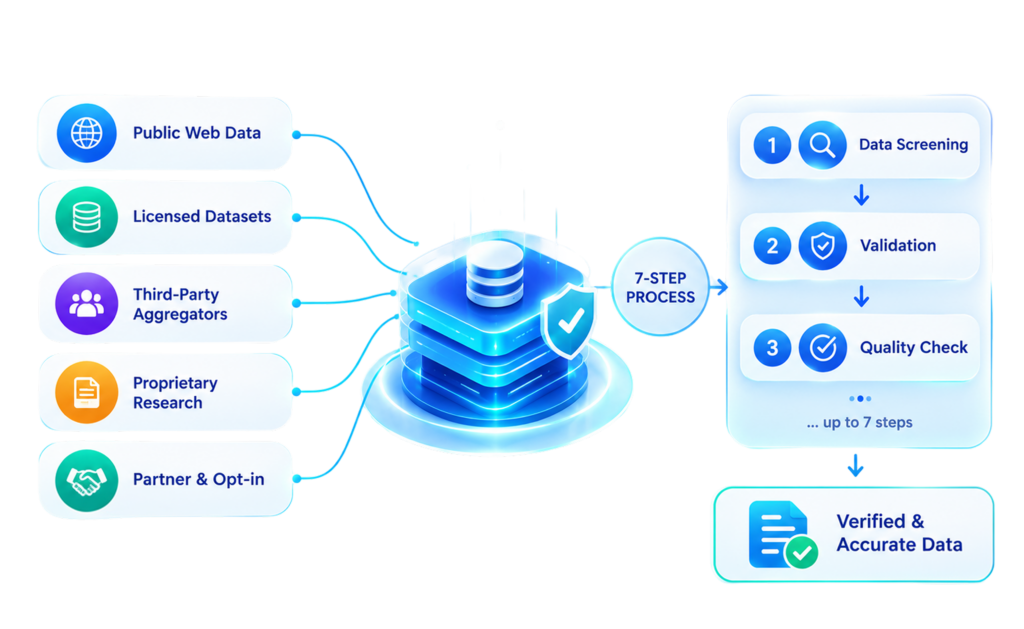
How We Source Our Data
DataCaptive builds its database from five distinct classes of source. Each class is governed by its own intake rules, refresh schedule, and rights documentation, and every record carries provenance metadata recording which class it came from, when it was collected, and under which jurisdiction. No record is published on the strength of a single source.

Public Web Data
- Establishing a company’s legal name, headquarters, website, and industry classification
- Confirming that a person holds the title and employer we have on file
- Detecting firmographic change signals — funding rounds, acquisitions, office openings, leadership moves
- Deriving technology and hiring signals used for intent and segmentation attributes

Licensed Datasets
- Extending coverage into regions and industry verticals where public sources are thin
- Supplying structured firmographics such as revenue bands, employee counts, SIC/NAICS codes, and corporate hierarchy
- Providing an independent second opinion when two other sources disagree on a field
- Backfilling historical attributes so records retain a change history, not only a current state

Third-party Data Partners
- Line-type, carrier, and portability lookups that distinguish a direct dial from a switchboard number
- Mailbox and domain reputation checks that feed the deliverability benchmark
- Address standardisation and postal validation against national address files
- Technographic detection used to tag the software a company runs

Proprietary Research
- Human verification of direct dials, including extension and reachability confirmation
- Confirming seniority, function, and decision-making scope behind a job title
- Mapping org structure and parent/subsidiary relationships for enterprise accounts
- Adjudicating conflicts that automated corroboration could not resolve

Partner & Opt-in Channels
- Capturing and retaining the consent basis and timestamp for each opted-in record
- Adding professional interest and topic attributes declared by the individual
- Refreshing contact details supplied first-hand by the person themselves
- Honouring channel-level preferences, including email-only or phone-only contactability
Records that cannot be corroborated by at least one independent source are held in quarantine rather than published, and quarantined records are excluded from every figure on this page. That is why our published counts are lower than our raw collection volume — we would rather publish a smaller database we can defend than a larger one we cannot.
What We Do Not Collect
- Government identifiers, national insurance or social security numbers
- Special-category data such as race, religion, political affiliation, or sexual orientation
- Financial account, card, or credit data
- Private message content, call recordings, or email bodies
- Health, biometric, or genetic information
- Data on individuals known to be minors, or consumer-only households
How We Verify Our Data
Every record passes through seven sequential checks. A failure at any tier sends the record back to quarantine — it is never partially published.
Source validation
Before a record is read, the batch it arrived in is checked for a valid licence or consent basis, a documented collection method, and a jurisdiction we are permitted to process. Batches from an unverified source are rejected at the door and never enter the pipeline.
Syntax & format checks
Every field is parsed against its expected shape: emails to RFC 5322, phone numbers to E.164 with country and area validation, addresses against national postal files, and names and titles against our normalisation dictionaries. Malformed, truncated, and placeholder values are discarded outright.
Deduplication & entity resolution
Probabilistic matching on name, employer, domain, and contact details collapses variants of the same person or company into one golden record with a stable, permanent identifier. Company records are then linked into parent, subsidiary, and branch hierarchies.
Cross-source corroboration
Each published field must agree across at least two independent sources. Where sources conflict, the value is chosen by a weighted score combining source reliability, collection recency, and specificity — and the losing value is kept in the record’s history rather than deleted, so later corrections are auditable.
Live deliverability testing
Each domain is checked for MX records and mail-server health, then the specific mailbox is confirmed through an SMTP handshake that stops before message delivery — no email is ever sent to the contact. Catch-all domains, role accounts, and disposable providers are flagged so they can be excluded from exports.
Human review sampling
Research analysts independently re-verify a statistically significant random sample of every batch by hand, including calling direct dials to confirm they reach the named person. If the sample’s error rate exceeds our threshold, the whole batch returns to tier 4 rather than being corrected record by record.
Compliance & suppression screening
Before release, records are screened against our permanent suppression list, national Do-Not-Call registries, and the processing rules of each contact’s jurisdiction. The same screen runs weekly against the live database, so a record that becomes non-contactable after publication is withdrawn without waiting for its next refresh.
45-Day
Every published record is re-validated end to end at least once every 45 days — not sampled, and not limited to records customers have touched. Fast-moving fields such as job title, employer, and phone status are monitored continuously between cycles, because roughly a quarter of business contacts change role or employer each year.
- Full-database revalidation - Every 45 days
- Job-change monitoring - Continuous
- Suppression & DNC re-screen - Weekly
- Records retired per cycle - ~3.1%
Accuracy by Dataset
| Dataset | Benchmark | How it is verified |
|---|---|---|
|
Contact data |
95% |
Validated through multi-stage automated verification and analyst review at each refresh, with non-deliverable, role, and catch-all addresses flagged and excluded from the benchmark. |
|
Direct dials |
85% |
Validated through phone intelligence checks that distinguish direct lines from switchboards, with analyst tele-verification on sampled records to confirm the number reaches the named individual. |
|
Email deliverability |
85% |
Observed accepted-delivery rate across anonymised, aggregated customer campaign returns, counting hard bounces as failures and excluding content- and reputation-based filtering. |
Deliverability depends partly on sender reputation and campaign content, which sit outside our control — the 85% figure reflects hard-bounce-free delivery under standard sending practice.
Database Size
Verified contacts
Phone numbers
Company profiles
Direct dials
Compliance & Certifications
We process business contact data under the frameworks below, and our controls are reviewed against them annually. Each entry links to the corresponding control documentation or regulator reference.

Certified

Certified

Compliant

Compliant

Compliant

Compliant
Frequently Asked Questions
How is the 95% accuracy figure calculated?
The 95%+ benchmark comes from our internal data-quality testing and validation processes, corroborated by validation results our customers report back to us — several of which come in above 95%. It is measured across multiple datasets and samples rather than a single record or campaign, and it reflects ongoing quality processes rather than a one-time historical test. Because the figure is evaluated per attribute, it should be read as a benchmark for the fields being supplied, not as a guarantee that every field in every dataset will always measure exactly 95%. Results can vary by geography, industry, persona, and data type, and internal testing documentation is available to substantiate the claim on request.